The Draft Treats Citizens as Property
- 10 hours ago
- 4 min read
Source: American Thinker
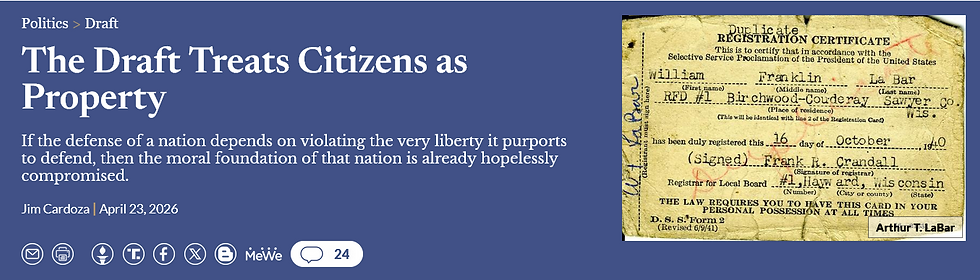
Last year, plans were revealed to initiate an automated military draft. It is scheduled to take effect in December 2026. Whereas the old system required a conscious acknowledgment of obligation, the new system imposes obligation by default. But rather than tinkering with the methods of deploying conscription, a free society would be better served by questioning the process altogether.
Why would a nation built on liberty, private property, and individual rights ever consider a military draft to be a legitimate tool of government? If people are free, they are presumed to own their own lives, their time, and their labor. By contrast, a draft assumes that citizens are government property. That concept is a principal element of slavery, not freedom.
Self-ownership is a fundamental premise of the free market. Individuals choose how to spend their time, what occupations to pursue, and whether to risk their lives for any cause -- including their country. But a draft implies that, in moments of its own choosing, the state may commandeer your service, like conscripting a mule to haul government goods. In any other context, forcing someone into involuntary labor would be rightly condemned. Yet, wrapped in patriotic language, this coercion is rebranded as duty.
Some will argue that the draft is a “necessary evil” in times of crisis. But if the defense of a nation depends on violating the very liberty it purports to defend, then the moral foundation of that nation is already hopelessly compromised. The same government that cannot force you to pick crops, or fix cars, or teach school, somehow presumes the right to force you into combat, even to die, for causes you did not choose and may not believe in. That is not a defense of liberty; it is an obliteration of it.
Consider the economic absurdity of the draft. In a free market, goods and services are exchanged voluntarily based on value. A soldier, like any other worker, should be free to negotiate the terms of his labor. A voluntary military is both morally defensible and economically efficient. It rewards those who choose to serve and allows the military to compete for talent, just as every other sector must. A draft eliminates this dynamic, replacing voluntary exchange with coercion and obedience. And like most government interventions, it introduces perverse incentives and waste.
There is also a philosophical flaw at the heart of conscription. To believe in the draft is to reject the idea that individuals are ends in themselves. Instead, it treats them as a means to an end -- the state’s end. The difference between a draft and a forced labor camp is one of degree, not principle.
One must also ask, who gets drafted, and who does not? History shows that drafts are never applied equally. The children of the elite often find ways to avoid service, while the burden falls disproportionately on the working class, on minorities, and on those with fewer political connections. The draft becomes not just an assault on liberty but a tool of exploitation. A moral society should not outsource its wars to the powerless by force.
Supporters of the draft often point to great causes -- fighting tyranny, defending freedom, saving civilization. These are noble ideals, and many will voluntarily fight for them. But when the cause is truly just, volunteers will rise to meet the moment. When the cause is murky or unjust, only the draft makes it possible. A draft does not reflect the will of the people -- it subverts it. It enables wars the public would not support if their own children were not dragged into it by force.
When the military has a recruiting problem, it is either failing to provide a compelling reason to join or the compensation is too low to entice enlistment.
In a free society, moral action requires consent. A war fought with slaves -- because that’s what draftees are, legally bound and stripped of choice -- is not a moral war. It is a war of compulsion. The draft trains citizens not in sacrifice but in obedience. It teaches that the state’s power over the individual is absolute in matters of life and death. A republic that tolerates such a practice cannot claim to be a consistent defender of liberty.
Ironically, those who call for a draft often do so in the name of “shared sacrifice” or “national unity.” But when an action is compelled, it is not sacrifice; it is servitude. True unity comes from shared values, not shared shackles. If soldiers must be forced into service, it is because a compelling case has not been made to justify war. A free country must earn its defenders, not seize them.
Those who advocate for free markets in goods and services must not flinch when it comes to the market for military labor. To exempt war from moral scrutiny is to exempt it from reason. A volunteer army, properly compensated, professionally trained, and morally respected, is not just more effective -- it is the only military compatible with a free society.
If freedom means anything, it must mean the right to refuse to kill and die for causes you do not choose. Otherwise, “freedom” is just a slogan used by those in power to demand your obedience.