
Leaked DHS And FBI Reports Reveal The Trump Administration Is Quietly Targeting 'Anti-Tech Extremism' And Americans Protesting Datacenters As 'Domestic Terrorists'
- May 28
- 11 min read
Source: Wine Press News
“The FBI warns that "paranoid views regarding AI" and "attempts to reason the belief that a godlike incarnation of AI is imminent," are viewed as "anti-tech extremism" and "neo-Luddites."

Protesting datacenters and other AI devices might get you considered a “domestic terrorist” and a form of “ant-tech extremism” by the Trump administration, according to internal documents from the Department of Homeland Security (DHS) and Federal Bureau of Investigations (FBI) recently obtained by WIRED.
The WinePress recently detailed the White House’s new Counterterrorism Strategy report — which has flown under the radar — which is built heavily on Trump’s National Security Presidential Memorandum 7 (NSPM-7), otherwise known as “Countering Domestic Terrorism and Organized Political Violence,” signed last September not long after Charlie Kirk’s assassination.
These documents, when dissected in their totality, reveal that most if not all Americans are now potentially viewed as domestic terrorist threats.
Both directives list strong implicit references to national databasing and pre-crime surveillance technology in order to deal with these ‘threats.’
The Trump administration defined a terrorist as “Narcoterrorists and Transnational Gangs; Legacy Islamist Terrorists; Violent Left-Wing Extremists, including Anarchists and Anti-Fascists.” In combination with NSPM-7, a “Left-Wing Extremist” really refers to anything the federal government determines is “anti-Americanism, anti-capitalism, and anti-Christianity; support for the overthrow of the United States Government; extremism on migration, race, and gender; and hostility towards those who hold traditional American views on family, religion, and morality.’”
Thus, it can be surmised and concluded that anyone that does not agree with the current administration’s ambitions and ideologies (and any further administration to come after) could be seen as a domestic terrorist.
Following the publication of the new strategy, White House counterterrorism official Sebastian Gorka, one of the authors of the recent CT report, presented an expanded definition as to what a so-called domestic terrorist would look like, referencing figures on the right such as Tucker Carlson and Nick Fuentes. He also reaffirmed the use of pre-crime surveillance technologies to “map” these targeted groups and individuals.
In the wake of attacks on CEOs, a nationwide protest movement targeting data centers, and increasing concerns about AI job replacement, federal intelligence agencies and domestic law enforcement are circulating reports with a new domestic target in mind: anti-technology extremists.
More than 1,000 pages of unpublished reports from the Department of Homeland Security, FBI, and fusion centers obtained by WIRED show a national shift taking place to surveil this new and worryingly broad category of people and activities deemed an emerging threat.
Taken together, these Trump administration directives — [NPSM-7 and the CT Strategy] — have commandeered the domestic surveillance apparatus to surveil and criminalize speech and assembly that challenges the ideology of the White House. A new focus on anti-technology extremism adds an unreported category to already public designations under a presidency that has heavily invested political and material capital in AI and data center proliferation.
These documents from DHS and the FBI, WIRED reports, “warns of widespread upheaval in response to AI adoption. One report states:
"The chaotic atmosphere that may result from emergent AI technology in the next five years may fuel large-scale protests that devolve into civil unrest and anti-tech violent extremist activity, especially in large urban areas such as New York City."
This newly-minted does not currently appear in any public administrative documents. The report also references Ziz Laota, “an extreme rationalist who allegedly led a small cultlike group, three members of which have been charged with murder, tied to an obsessive ideology focused on the existential risk posed by AI.”
The Zizians are being used as a case example to therefore a broader range of Americans are critical of the rapid AI and datacenter rollout in the country.
“The Intelligence Bureau warns that "paranoid views regarding AI" may proliferate in the aftermath of the Zizians' trial, thanks to their "attempt to reason the belief that a godlike incarnation of AI is imminent," and belief that "humans must best use their time in the present to devote themselves to ensuring its compliance with human morality, or face existential consequences for failing to do so."
The documents further reveal the use of fusion centers, a post-9/11 creation — which are, according to DHS, “state-owned and operated centers that serve as focal points in states and major urban areas for the receipt, analysis, gathering and sharing of threat-related information between State, Local, Tribal and Territorial (SLTT), federal and private sector partners.”

These fusion centers are being used to track and monitor criticism of the AI rollout. WIRED reported:
A Western Pensylvania fusion center, for example, claimed that “adversarial actors, including state-sponsored entities, criminal groups, and extremists, such as homegrown violent extremists or environmental extremists, may target US data centers” and that “these actors could also exploit the strategic importance of data centers to the US economy, using them for activities like cryptocurrency mining or leveraging third-party entities, such as front companies, to gain access to US data and infrastructure.”A report from the Northern Virginia Regional Intelligence Center warned that AGAAVEs—anti-government, anti-authority violent extremists—influenced by government-related grievances and conspiracy theories, have engaged in pre-operational planning targeting data centers and other critical infrastructure facilities to disrupt government operations. But in the breakdown of Suspicious Activity Reporting indicators, the intelligence report lists activities that could easily be carried out by peaceful protesters, legal experts say.
Spencer Reynolds, senior counsel at the NAACP Legal Defense Fund, told WIRED:
“These intelligence reports are part of a long tradition of agencies identifying protest or even simply having strong opinions as precursors to violence. Suspicious activity reports are incredibly unreliable, often about vague or innocent behavior, issued under permissive standards. These reports, often received in large volumes, allow officers to inject their own biases and see what they want to see in the facts.”
WIRED also points out:
Under US law, domestic terrorism is not a stand-alone crime that is brought to bear during trial. Instead, domestic terrorism laws allow for targeting and surveillance of extremists, with charges sometimes bearing terrorism enhancements and sometimes excluding them altogether. This has led to protesters and activists being surveilled under domestic extremism provisions while being charged with crimes like criminal trespass and vandalism.
Mauro Lubrano, an expert into so-called anti-technology extremism, had has work and lectures also appear in these fusion centers; and he defines three primary strains of a newly coined threat matrix: “insurrectionary anarchists, eco-extremists, and ecofascists.” He argued that violence is “unaccepatable,” he said that regular civilians should not be used “as an excuse to securitize AI and emerging technologies, thereby silencing those who are critical of the current trajectory,” he told WIRED.
In a statement to WIRED, the FBI commented:
“The FBI investigates individuals who commit or intend to commit violence and criminal activity that constitutes a federal crime or poses a threat to national security. We have no additional comment.”
But the FBI is painting with a broad brush, their documents reveal.
One of these fusion centers, located in Virginia, “circulated a report in March showing monitoring of constitutionally protected events and demonstrations related to critical views on technology.” These included events of organized protests and riots at Tesla dealerships or activist groups rallying against investment in Israeli weapons manufacturer Elbit.
Furthermore, WIRED revealed that “open source intelligence companies that contract with federal law enforcement agencies appear to be scouring the web for what they claim to be anti-technology sentiment as well.”
In January 2025, SITE Intelligence transferred information to fusion centers claiming “conversations in a “neo-Luddite” Discord server had turned violent, with one user of the group called for violence against tech CEOs and power plants.” A Luddite has become a colloquial term “used to describe people who dislike new technology,” History.com says, “but its origins date back to an early 19th-century labor movement that railed against the ways that mechanized manufacturers and their unskilled laborers undermined the skilled craftsmen of the day.”
Reynolds told WIRED:
“SITE is a for-profit private intelligence firm that monitors social media for its law enforcement customers. It promises to do an incredibly difficult if not impossible job, consistently mining social media written by anonymous posters, full of in-jokes, slang, different languages, vagueness, and so on, to deliver credible information that can predict threats. Instead, this type of activity tends to focus on people’s views about things like policing, abortion, economic inequality, vaccines, or any other hot-button topic of the day.”
Rita Katz, founder of SITE, told WIRED via email that their “reports have shown a notable spike in online threats advocating for sabotage against data centers, which is a true cause for concern.”
Bute SITE is flagging nonviolent criticism and reporting that as potential domestic terrorism.
“[An April 2025] report flags a video from the progressive nonprofit More Perfect Union on the destructive effects of a data center to nearby residents in Georgia. Nothing in the video advocated for violence against property or people. But thanks to fusion center targeting, the advocacy group is now circulating among US intelligence and law enforcement across the country as a potential threat vector.”
More Perfect Union is one of many groups, along with ordinary citizenry, exposing corruption related to the datacenter rollout.
Earlier this month, a massive datacenter, set to become one of the largest in the world, funded by multimillionaire and Shark Tank entrepreneur Kevin O'Leary, was approved in Utah, which sparked immense backlash from residents.
O’Leary then went on a media tour claiming that these protesters and fuming residents were sponsored protestors being bussed in by China.

As vitriol against datacenters and the AI rollout grows, big-tech, private interests, and federal and state governments are beginning to clamp down on dissent and intimidate those that would speak out.
For example, a Texas woman was recently arrested after making a Facebook post exposing how a nearby datacenter had completely tainted and poisoned the water supply.
Jennifer Combs posted an alert to her local watchdog group in April urging residents who have been made sick by the city’s tap water to come forward.
“We have received reports that some citizens have been hospitalized due to bacteria in the water. This is a serious public health concern that deserves immediate attention,” she wrote. “If your water looks discolored, contains sediment, has a strong odor, or you have experienced related health issues, please send us a message. We are gathering information and reporting findings to the state.”
She would eventually be arrested on May 8th in what Trinidad Police Chief Charles Gregory called a “cut and dry” case, and contended her claims about hospitalizations “are simply false and have only caused unnecessary fear and confusion in our community.” The police department claimed the woman posted “false information that creates fear, panic, or unnecessary emergency response within a community.”
Meanwhile, a young lady from Georgia, Ansley Brown, went viral after she exposed how Georgia Power is attempting to evict residents in Coweta and Fayette counties via eminent domain so they can build a datacenter and necessary power supplies in her neighborhood.

Since speaking out, some of her social media accounts have been censored and terminated.

Moreover, BlackRock CEO and World Economic Forum co-chair Larry Fink recently revealed at a forum event hosted by the Milken Institute, joined by Brookfield CEO Bruce Flatt, that he was worried about alleged domestic terrorists that could damage or destroy the datacenters BlackRock is funding, and that he is looking to increase security apparatuses to prevent any uprisings.
“But now, because of drone warfare, we have to relook at all forms of security. […] So many more things are going to have to be underground. But even here in the United States, if we’re going to be building, let’s say, these one-gigawatt data centers, how do we make sure we’re not protecting those $50 billion, $75 billion investments?“We have to relook at everything because of the role of drone warfare. Right now, we’re looking at it internationally. But one of my concerns is, could it be a domestic terrorism using a $3,000 drone?
Fink also recently revealed in a press conference in Texas that the trillions of dollars needed to fund these datacenters will come from private savings accounts and pension funds.
But this demonization and suppression of Americans’ speech and criticism is compounding people’s hesitation and skepticism.
According to US News:
Seven in 10 Americans oppose the construction of data centers for AI in their local area, according to a Gallup poll published May 13.
Nearly half of respondents said they “strongly” opposed the construction, and an additional 23% said they “somewhat” opposed it.
“Half of opponents mention data centers’ excessive use of resources, including 18% each mentioning their use of water and energy,” according to Gallup. “Sixteen percent mention a related environmental concern of pollution, including noise pollution and air and water pollution.”
Air, noise and water pollution from data centers can lead to health problems for humans, as U.S. News has previously detailed. Long-term impacts may include increased risk of respiratory disease, cardiovascular disease, mental health struggles, stroke, diabetes and reproductive harms like miscarriage and stillbirth.

Such concerns so far haven’t been enough to halt the AI buildout. The U.S. has more than 4,000 data centers, which is nearly eight times the number of any other country. Thousands more are planned or under construction.
Despite the fact that corporations and governments are ignoring what their residents think, the pushback has still led to delays and project cancelations.
That, and because of America’s zeal to build all these datacenters and AI infrastructure, the U.S. is lacking in resources to build and power them.
As reported by ZeroHedge in April (emphasis theirs):
As Canaccord Genuity analyst George Gianarikas writes, “the American data center boom is hitting a formidable wall of logistical friction.” He is referring to the latest outlook by Sightline Climate, which is also reinforced by recent articles from Bloomberg and others, and reveals a sobering reality for 2026: nearly half of the nation’s planned 16-gigawatt capacity faces cancellation or delay, with only 5 gigawatts currently under construction.
This inertia stems from a volatile mix of local permitting hurdles, community resistance, and a desperate reliance on overextended global supply chains for critical components like transformers and helium.
That’s right: despite $700BN+ of expected 2026 hyperscaler capex, nearly half of the data centers scheduled to begin operations in the US in 2026 “will either face delays or outright cancellations.” The data, which comes from Sightline Climate’s 2026 Data Center Outlook, suggests that just 30% - 50% of the ~16 GW of planned US capacity for the year will face risks, with only ~5 GW currently under construction!
“We expect 30-50% of 2026 projects to be delayed, driven by power constraints (25% of projects have not disclosed powering strategies), increasingly effective community opposition, and potential grid equipment shortages. 11GW of 2026 capacity remains in the announced stage with no signs of construction, despite typical build times of 12 to 18 months. Itʼs still possible for this capacity to come online, but it would need to dramatically accelerate.”"Without a radical acceleration in domestic manufacturing and grid integration, the digital expansion of the late 2020s risks stalling into a series of unfulfilled promises."
Nevertheless, President Donald Trump has signed executive orders establishing a singular national rulebook on AI, allowing tech companies and private interests to bypass state regulations and receive immediate federal clearance.
However, Trump revealed he did refrain from signing another similar EO last week, canceling a White House signing event with big-tech executives, claiming that the wording of this latest EO did not meet his approval. “We’re leading China, we’re leading everybody, and I don’t want to do anything that’s going to get in the way of that lead,” he said.
The Associated Press noted: The order would have established a framework for the government to vet the national security risks of the most advanced AI systems before their public release, according to a person familiar with the White House’s deliberations with the tech industry but not authorized to speak about them publicly. The directive was being characterized as a voluntary collaboration with participating U.S.-based tech companies, including Anthropic, OpenAI and Google, the person said.
Nevertheless, the federal government is still quietly ramping up measures to deal with AI dissidence.
As reported by Dan Boguslaw and Ken Klippenstein, the U.S. Capitol Police Intelligence Services Bureau, a new intelligence agency for Congress created after the riots at the Capitol on January 6th, 2021, published a warning bulletin in April concerning Americans protestors datacenters.
“ISB has prepared this Intelligence Note to provide the US Capitol Police and law enforcement personnel with information related to recent threats and attacks likely linked to grievances concerning data centers,” the report says.

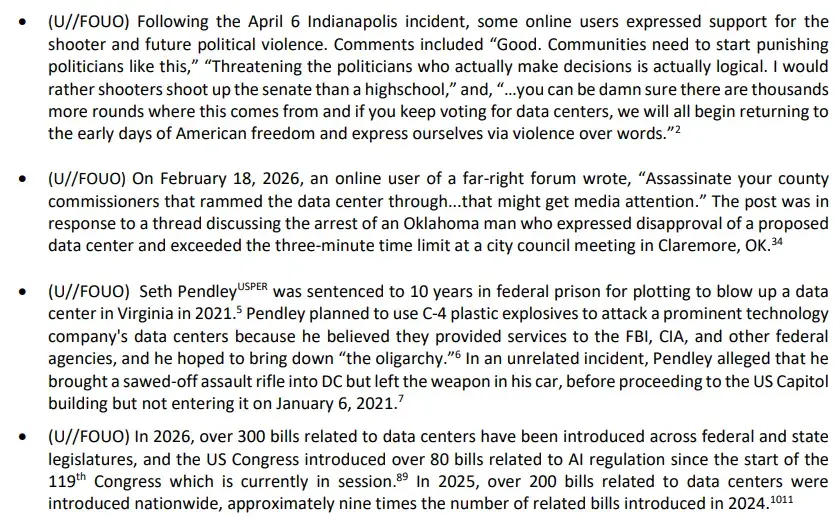

However, the report reveals: “The US Capitol Police is not investigating any data center-motivated threats to Members of Congress; however, related policies introduced on the Hill and in local communities are likely to continue drawing opposition, increasing potential concerns for public officials.”

“We now have a world class intelligence operation,” then-Chief of the U.S. Capitol Police Thomas Manger said last May. “We are significant players in the intelligence community in the Washington, D.C., region and, frankly, all over the country … Whereas before, we were basically just — we were consumers of information. The FBI would give us intelligence, other agencies would give us intelligence. Now we are gathering our own.”


