
Putin is preparing for 'Pearl Harbor in space' nuclear attack, US military chief warns
Source: Daily Mail
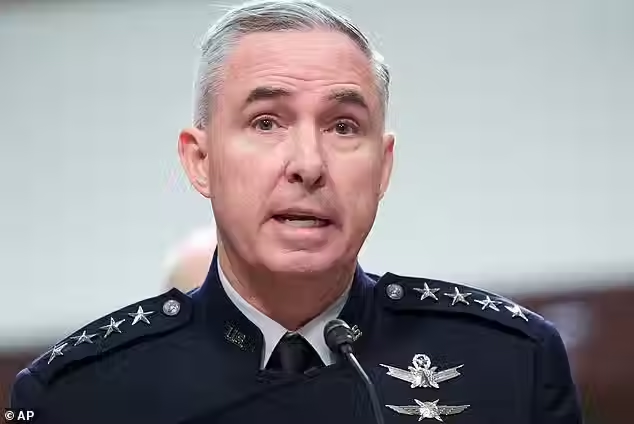
Vladimir Putin is planning a Pearl Harbor-style attack against satellites in space that could cause pandemonium across the world, a US military chief has warned. General Stephen Whiting, the head of US Space Command, said that the Trump administration is 'very concerned' by the Kremlin's plans.

Whiting told the Times: 'They are thinking about placing in orbit a nuclear anti-satellite weapon that would hold at risk everyone's satellites in low Earth orbit, and that would be an outcome that we just couldn't tolerate.'
He added: 'Russia remains a sophisticated space power and they continue to invest in counter-space weapons.'
Asked why Russia would want to place nuclear weapons in space, he said: 'From a Russian perspective, they look at the United States, they look at NATO and they see an overmatch there of conventional arms.
'And they believe that novel ways of trying to undermine the United States and NATO, such as by neutralising our space capabilities, helps them to level the battlefield.'
He declined to comment on how the US came to its understanding of Russia's plane. If true, they would be a major violation of the Outer Space Treaty. which Russia is a signatory to.
It would also be the latest evolution in Russia's strategy of increasing its aggression in space, which Whiting said included 'sustained satellite communication and GPS jamming' at such a large scale that it puts 'civilian airliners at risk.'
In light of Russia's increased aggression, the heads of the EU and NATO today discussed efforts to bolster Europe's arms production, as US President Donald Trump throws doubt on Washington's commitment to the transatlantic alliance.
'We need to invest more, to produce more and to do both faster,' European Commission president Ursula von der Leyen posted online after meeting NATO chief Mark Rutte.
European nations are scrambling to bolster their militaries in the face of Russia's war on Ukraine and pressure from Trump.
Fears over Washington's role in NATO have been heightened as the mercurial US leader has threatened he could leave the alliance in anger over the European response to his war in Iran.
NATO allies last year pledged to ramp up core defence spending to 3.5 percent of GDP in a bid to assuage Trump's criticism that Europe was not spending enough on defence.
But there are ongoing complaints that Europe's defence industry is failing to keep pace and is not able to meet the new, higher demands despite a raft of initiatives from the EU.
NATO officials say that the issue of industrial production is set to be one of the central topics for the alliance's upcoming summit in Ankara.
Rutte - who held talks with Trump in Washington last week - posted online that a 'stronger Europe means a stronger NATO'.
He wrote that he had discussed with von der Leyen 'how to further strengthen our essential NATO-EU cooperation, including ramping up defence industrial production, continuing vital support to Ukraine, and protecting critical infrastructure.'
The United States has said it wants to see European allies take over the conventional defence of their continent, so that Washington can focus more on other threats such as China.
European countries meanwhile are realistic that decades of relying on America to keep Europe safe are over and that they increasingly will have to take their security into their own hands.
The EU - which long shied away from defence issues - has massively ratcheted up its efforts to bolster industry in recent years, and some countries are asking if it can play a bigger role.
NATO officials insist that the bloc should focus on its core strengths such as marshalling funding and not stray into the alliance's traditional field of military planning.

