Pentagon Announces 6 Critical Areas for Research and Development - Tech Company Opportunities
- Nov 18, 2025
- 2 min read
Date: November 18, 2025

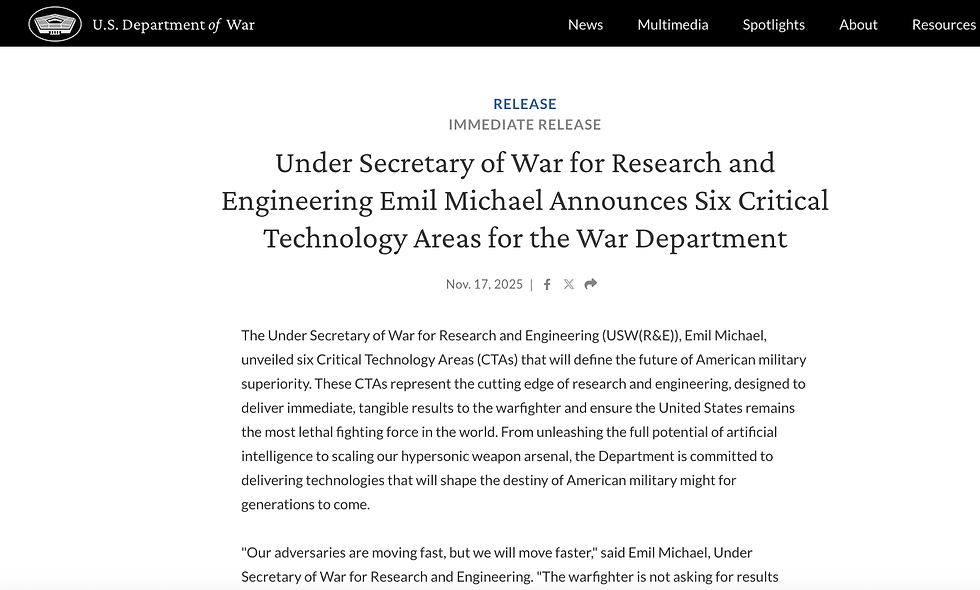
The Pentagon on Nov. 17 announced that it would designate six “Critical Technology Areas (CTAs)” to focus government funding for research and innovation in military technology. The six areas are as follows: Applied Artificial Intelligence (AAI), Biomanufacturing (BIO), Contested Logistics Technologies (LOG), Quantum and Battlefield Information Dominance (Q-BID), Scaled Directed Energy (SCADE), and Scaled Hypersonics (SHY). The Pentagon only indicated the department’s focus on these areas and did not announce any funding commitments.
“Our adversaries are moving fast, but we will move faster,” wrote the Under Secretary of War for Research and Engineering Emil Michael in the department’s statement about the CTAs. “The warfighter is not asking for results tomorrow; they need them today.
“These six Critical Technology Areas are not just priorities; they are imperatives. The American warfighter will wield the most advanced technology to maximize lethality. This is how the Department wins wars,” Michael added.
“Our nation’s military has always been the tip of the spear,” Secretary of War Pete Hegseth said in remarks on the announcement. “Under Secretary Emil Michael’s six Critical Technology Areas will ensure that our warriors never enter a fair fight and have the best systems in their hands for maximum lethality. The Department is committed to remaining the most deadly fighting force on planet Earth.”
A memorandum regarding the new CTAs obtained by The Epoch Times indicates that the areas were chosen based on various factors, such as the ongoing war between Russia and Ukraine, the development of hypersonic missiles by communist China, and the race to artificial intelligence.
Under the Trump administration, the Pentagon has sought to increase government involvement in military research and development, particularly through partnerships with small start-up companies developing new technology to sell to the U.S. government, rather than merely the large defense contractors such as Lockheed Martin, Raytheon, Boeing, and General Dynamics. Some new companies closely affiliated with the department are Palantir, Anduril, SpaceX, and others.
Most notably, the chief executive officers of several of these companies—i.e., chief technology officer of Palantir, Shyam Sankar; chief technology officer of Meta, Andrew Bosworth; head of product at OpenAI, Kevin Weil; and Thinking Machines Lab advisor Bob McGrew—have been commissioned into the U.S. Army Reserve as lieutenant colonels, assigned to the “Executive Innovation Corps,” which was intended to bring “private-sector know-how into uniform.”
A lieutenant colonel or equivalent (i.e., rank O-5) in the U.S. military generally has at least 15 years of service in uniform.