
Missiles don’t lie: What this region’s rocket stockpiles say about the next war
Source: RT News
Date: August 31,2025
How growing arsenals and proxy wars are pushing the Middle East closer to the brink
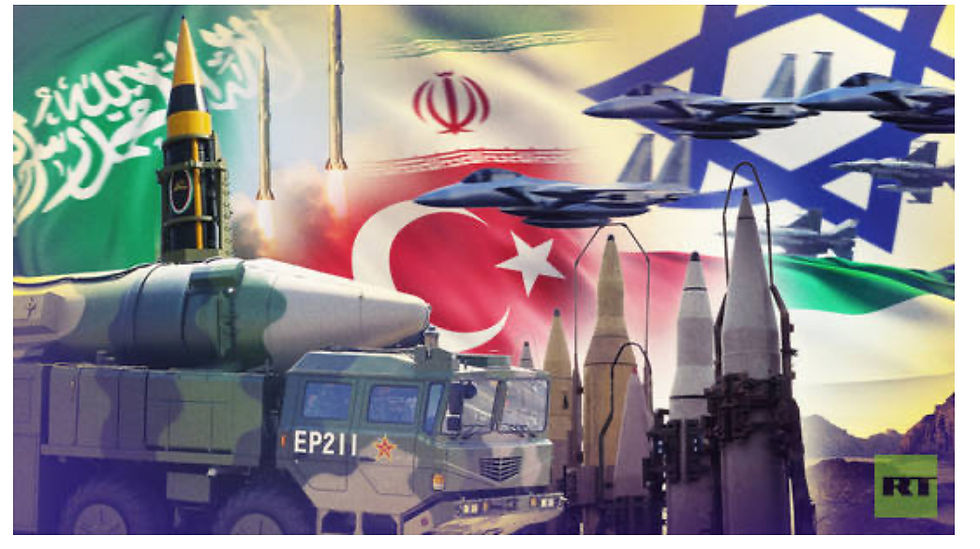
Modern conflicts are increasingly hybrid, blending conventional warfare with cyber operations, economic pressure, and proxy battles. Nowhere is this more visible than in the Middle East – where the interests of the US, Russia, China, Iran, Türkiye, Israel, and the Arab states collide.
In this environment, missile arsenals have become one of the decisive tools of war. Alongside airpower, they allow militaries to strike across great distances, punch through defenses, and project strategic pressure far beyond their borders. To understand the balance of power in the region, it’s essential to look at the missile capabilities of its key players.
Iran: Missiles as the core of deterrence
Despite the June 2025 clash with Israel – which exposed some vulnerabilities and cost Tehran a number of assets – Iran still fields the largest and most diverse missile arsenal in the Middle East. Its rockets are deployed both directly by the Iranian military and indirectly through proxy groups such as Hezbollah in Lebanon, the Houthis in Yemen, and Shia militias in Iraq.
Iran’s arsenal covers a wide range of systems:
Short- and medium-range ballistic missiles (500-2,500km).
Solid-fuel designs that increase survivability and reduce launch prep times.
A growing focus on hypersonic technology, with the two-stage Sejil capable of reaching 2,500km and reportedly carrying a reentry vehicle traveling at up to Mach 10.
The Fateh-110, a precision-guided missile with a range of 300km and a circular error of less than 10 meters thanks to satellite navigation.
The liquid-fueled Khorramshahr, with a range over 2,000km, can carry multiple warheads to overwhelm missile defenses during a mass strike.

